

I have a fascination with architectural styles, especially those pertaining to historical eras. Our modern architecture unfortunately suffers from a lack of creativity, colors, and details. There was a time when every brick, wall, and floor was finely handcrafted by the most talented artisans. Of course, such buildings still exist today, but they are few and far between, and becoming less and less common. We are often met with stale and plain buildings or tall and shiny skyscrapers. Do not get me wrong, I think skyscrapers are impressive, but they do not make you feel as if you are staring at an intricate art piece like Gothic, Islamic, Dravidian and many other traditional styles of architecture do.
So today, I would like to specifically focus on a style of architecture that is near and dear to my heart. Sudano-Sahelian architecture is present in the Sahel and Sudan Region of West Africa; there are numerous buildings that serve as examples of Sudano-Sahelian architecture. Sudano-Sahelian architecture started around 2,500 B.C with one of the earliest known examples being the city of Djenne-Djenno, Mali, which started construction in 250 B.C.
Sudano-Sahelian buildings are constructed with mud bricks and plaster. Mud bricks serve as a versatile and convenient building material. The bricks are a mixture of soil, water, and corn husks. Weather in the Sahel and Sudan Region is exceedingly hot, so mud bricks were used to build houses because of their ability to remain cool in desert climates. Plaster was also used as a building material. Plaster, like mudbrick, is able to remain cool in warm climates because it is made from the same materials. However, plaster has to be reapplied every year to maintain the structure. Wooden beams that protrude through walls provide support and are used as scaffolding when plaster has to be reapplied.
One of the most famous examples of Sudano-Sahelian architecture is the town of Djenné. Djenné is a town located in Mali. It is estimated that in 200 B.C, Djenné started to have settlements and the city urbanized sometime after 300 A.D. Djenné has multiple examples of Sudano-Sahelian architecture.
Traditional houses in Djenné are constructed with an inner courtyard and are built with mud bricks. They have two floors and are flat roofed. A traditional house includes wood from the rônier palm tree. Wood from the tree is turned into wooden beams called Toron. Toron is also used on the exterior of the house as decoration and scaffolding, providing a structure for people to stand on when doing the annual repairs of the buildings. Yearly repairs for community buildings like the Great Mosque of Djenné are accomplished together and celebrated as a community through festivities that includes food and music.
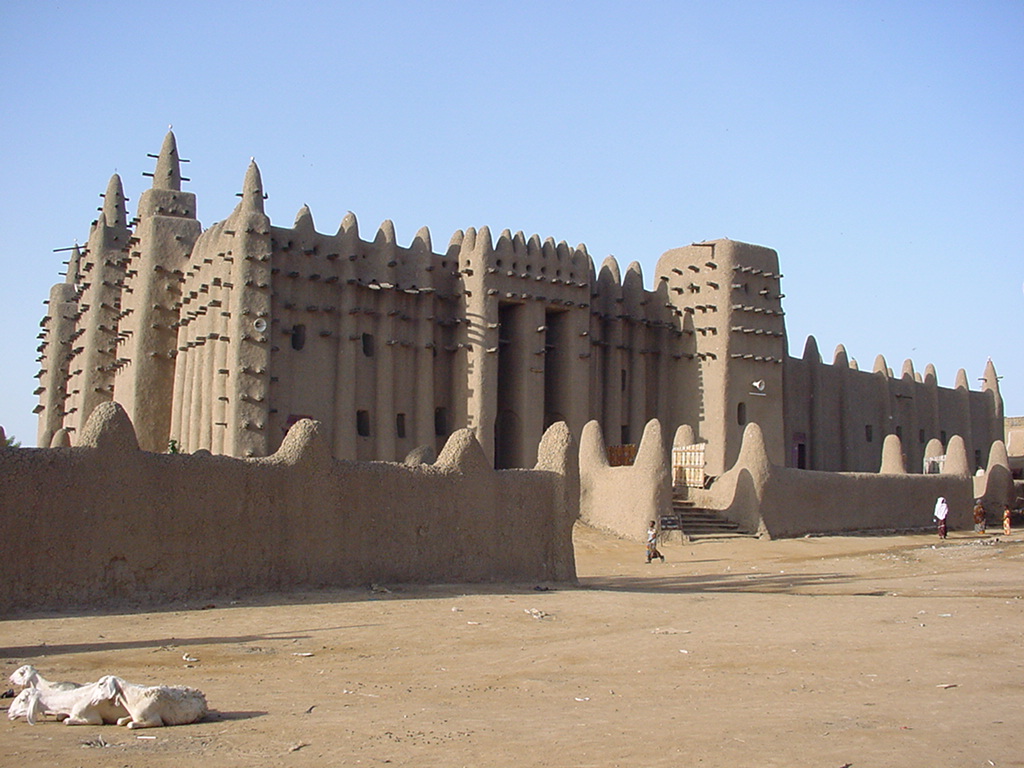
The Great Mosque of Djenné in Djenné, Mali, is the largest clay structure in the entire world. A UNESCO World Heritage Site and still in use today, the mosque is a community pride. The structure has been rebuilt multiple times and the current building was built in the early 1900s. Oral tradition states that the first mosque was built when the sultan converted to Islam. The sultan tore down his palace and ordered that a mosque be built in its place. The mosque took several years to finish. It was not completed until his third successor in the 1200s.
Centuries later, in 1818, the town was captured by Fulani conqueror Seku Amadu. He built a new mosque and let the old one fall into disarray because he was not fond of it. In 1893, Djenné was taken over by the French military and fourteen years later, the French administration ordered that the Great Mosque of Djenné be rebuilt. The mosque was rebuilt by Djenné’s local masons in the traditional building method. This version of the mosque is the one we still see today.
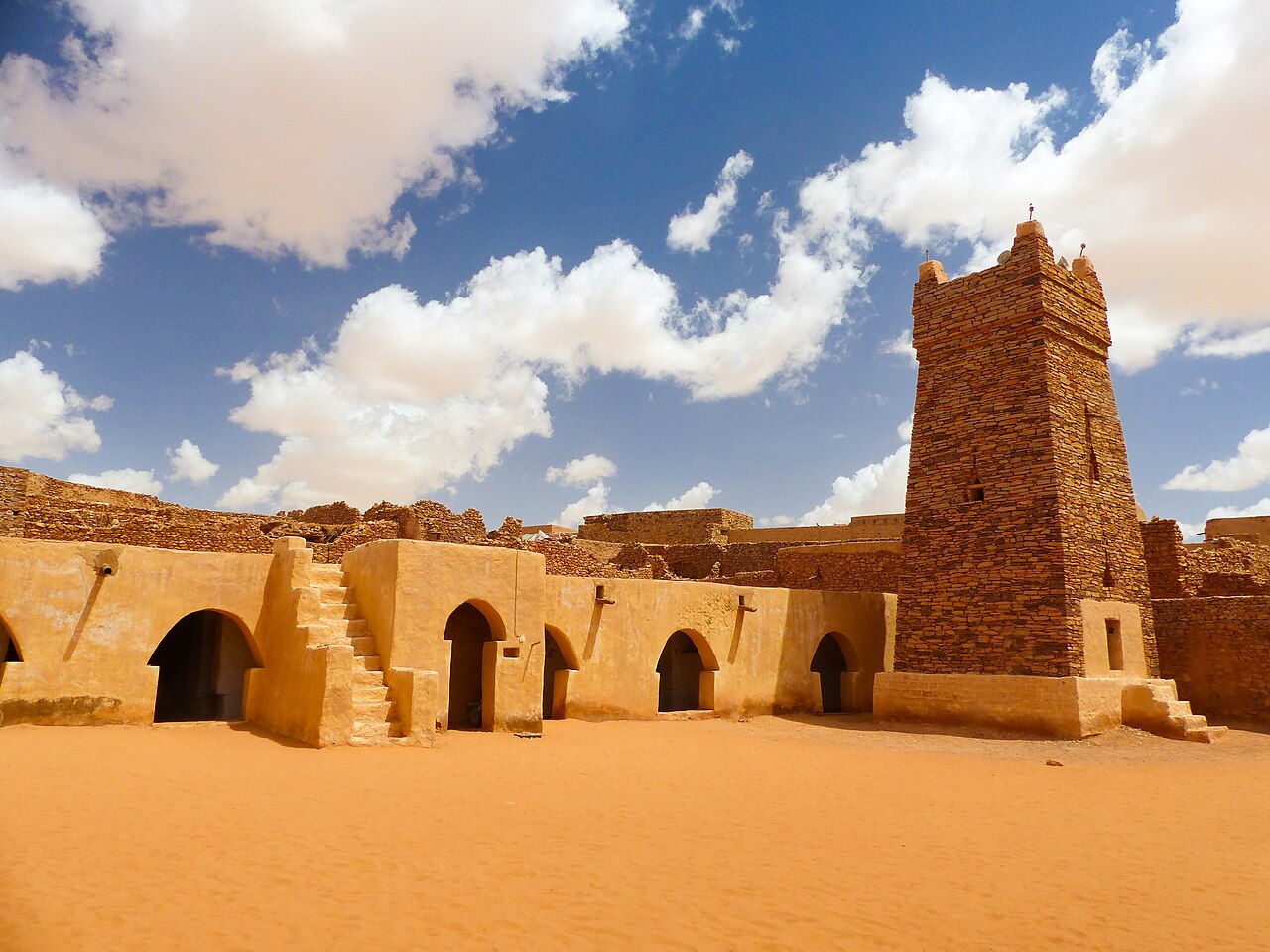
Another prominent example of Sudano-Sahelian architecture is also a mosque, The Chinguetti Mosque is a traditional worship building built in the thirteenth century in Chinguetti, Mauritania. The Chinguetti Mosque features a prayer room, courtyard, and tower. Unfortunately, the building is in danger of destruction because of the harsh desert weather.
The city of Agadez in Niger has a historic interior which is known for its Sudano-Sahelian Architecture. Agadez has many buildings built in this traditional style, but the significant ones are the Kaocen Palace, the Agadez Sultan’s Palace and the Agadez Mosque. The city of Agadez was built sometime before the fourteenth century and today has a population of over 100,000. The Agadez Mosque is the tallest mud brick structure in the world and is still used as a place of worship today.
As an homage to traditional buildings and African culture, the African Heritage House was built in the 1980s. The African Heritage House is a fusion of modern and traditional African architecture. Designed by Alan Dovovan and built in Kenya, the building offers a unique blend of African architectural styles. The African Heritage House is mostly inspired by The Great Mosque of Djenné, but the house also takes inspiration from Morocco, Swahili, Zanzibar, Lamu, Ghana, and Burkina Faso.

The African Heritage House was created by Kenyan Politician Joseph Murumbi and Alan Dovovan. They wanted to sell African art and promote African culture around the world. Now, the building overlooks the Nairobi National Park and host thousands of art pieces. The house serves as a museum but also as a place to hold tours, dinners, and conferences.
As countries all over the world continue to change, modernize, and expand the protection of traditional architecture is essential for maintaining cultural preservation. The African Heritage House serves as example on how countries can mix modern and traditional architecture when building new structures.
Leave a Reply